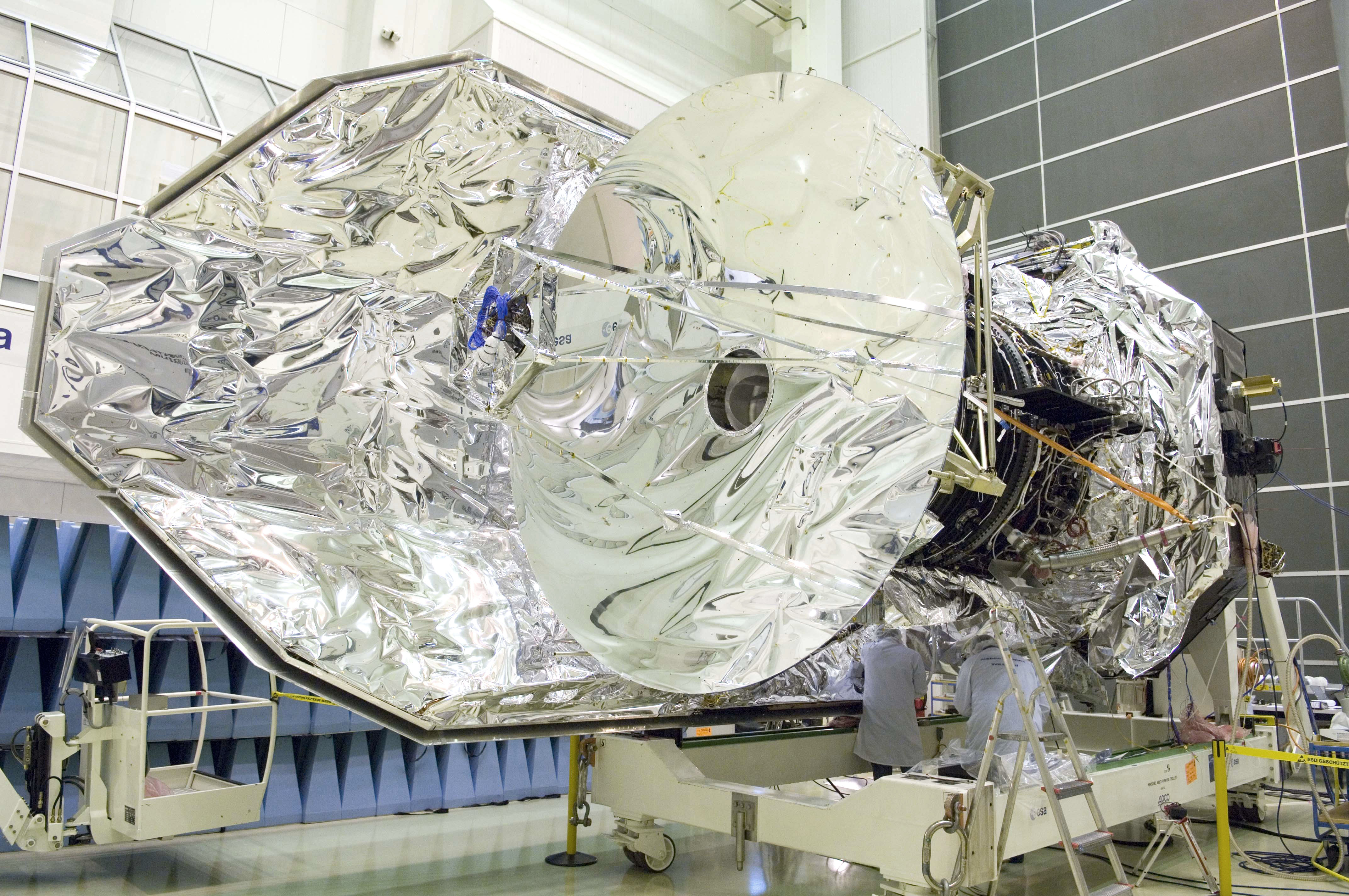
Herschel Space Observatory – launched 14th May 2009
Why is Herschel so important?
It is the most powerful infrared telescope ever launched.
It is named after William Herschel an astronomer who discovered the planet Uranus in 1781. He is also well known for his discovery of infrared radiation. He was passing sunlight through a prism and measuring the temperature of each of the colours of the spectrum. He was amazed to find that when he moved the thermometer beyond the red band the temperature went up even higher – he had discovered infrared radiation.
The Herschel space observatory has the largest mirror ever launched into space. It is 3.5m in diameter, Hubble’s is 2.4m.
The instruments on the telescope need to be kept as near to absolute freezing as possible. The liquid helium used, helium II, is at a temperature just below -271°C, absolute zero is -273.15°C or 0 Kelvin. The instruments need to be so cold in order that they can accurately detect the infrared radiation during their observations.
The observatory will only operate while the helium II is still present. This will evaporate over time, and scientists predict it will only last 3½ to 4 years. Herschel was first conceived in 1982, it launched in 2009 and by 2012 it will no longer be sending back data. However the data it sends back during this time will take many years to analyse.
So where is Herschel now?
Herschel is in a very high orbit. It is orbiting the second Lagrangian point, about 1.5 million km from the Earth. Remember the moon orbits the earth at an average distance of about 380,000 km, so Herschel is about 4 times that distance away.
This orbit was chosen as it is on the opposite side of the Earth to the sun. It is a stable thermal environment, which means that it is easier for the telescope to shield itself from the infrared radiation being released by the sun, and obtain accurate readings from far out into the galaxy and universe beyond.
So what is Herschel looking for?
It is looking particularly at ‘cool’ areas of the galaxy – remember cool here is relative, a celestial body may have a temperature of 2000°C, which is cool compared to our sun which is about 5000°C!
The advantage of looking at infrared radiation is that it can look through dust clouds to see what is inside, an optical telescope can only see the dust.
Herschel is looking at the formation of stars and galaxies. Astronomers want to know how galaxies formed, did they all form at the same time? Have stars always formed in the same way throughout time? Or does the situation depend on the type of galaxy and the age of the universe? Herschel is the first observatory capable of studying the earliest stages of star formation – and already, in its test phase, it is sending back some quite incredible images.
On 3rd September 2009 Herschel took this image (left) of a cool, dark region near the Galactic Plane. The fact that this dark, cool area is so full of activity was very unexpected – new stars are being formed in our constantly changing galaxy. It will be fascinating to follow Herschel’s findings in the coming years.